
The Comparison Everyone Runs, and Why It Misses the Point
Ask ten engineering teams why they picked Linear over Jira, or Jira over Linear, and nine of them will answer with an adjective: "Linear is fast." "Jira is flexible." "Linear feels clean." "Jira can do anything."
Those answers aren't wrong. They're just incomplete. Speed and flexibility are symptoms of a deeper design decision each tool made a long time ago, and that decision — not the UI polish — is what determines whether the tool still fits your team in eighteen months.
Linear was built by engineers, for engineers, with a strong opinion about how software teams should work: short cycles, a lightweight triage step, minimal ceremony. Jira was built to be a system of record for any team doing any kind of work, which means it has almost no opinion at all — it has configuration options instead.
That's the actual comparison. Not "which one is nicer to use," but "which one's built-in theory of how work should flow matches the shape of your organization."
What Each Tool Is Actually Optimized For
Linear optimizes for a single kind of team: a product engineering group that plans in short cycles, triages incoming work fast, and wants the tool to disappear so people can talk about the work instead of the tracker. Cycles, Triage, and Projects aren't just features — they're an encoded workflow. You don't configure Linear's workflow so much as adopt it.
Jira optimizes for an organization, not a team. It assumes Legal needs an approval workflow, Support needs SLA fields and escalation paths, Engineering needs sprints and story points, and someone in the middle needs all three to roll up into one dashboard for a quarterly review. Jira's complexity isn't accidental bloat — it's the cost of being the one tool every department can bend into its own shape.
This is the part most comparisons skip: Jira's flexibility and Linear's speed are the same design decision, viewed from opposite sides. A tool that must serve every department cannot also be opinionated about any one of them. A tool that's opinionated about engineering work cannot also flex cleanly into legal approval chains.
The Workflow Difference in Practice
Take something concrete: a bug report comes in.
In Linear, it lands in Triage. Someone — often on a rotation — looks at it within a day, assigns a priority, and either kills it or drops it into the current or next Cycle. There's no separate "workflow" to configure; the state machine is Backlog → Triage → In Progress → Done, and every team in the workspace uses roughly the same shape. The system's opinion is that bugs should move fast, cycles should stay short, and anything that doesn't fit that rhythm gets punted quickly rather than accumulated.
In Jira, the same bug hits a project with its own workflow scheme — maybe five or eight statuses, custom fields for severity and affected version, an approval step if it touches a regulated system, and automation rules that route it to the right component owner. None of that is wrong. If you're shipping medical device firmware or handling billing disputes, you want an audit trail and a formal state machine. But it means every project can look different, and new hires spend real time learning "how tickets work here" before they can be productive.
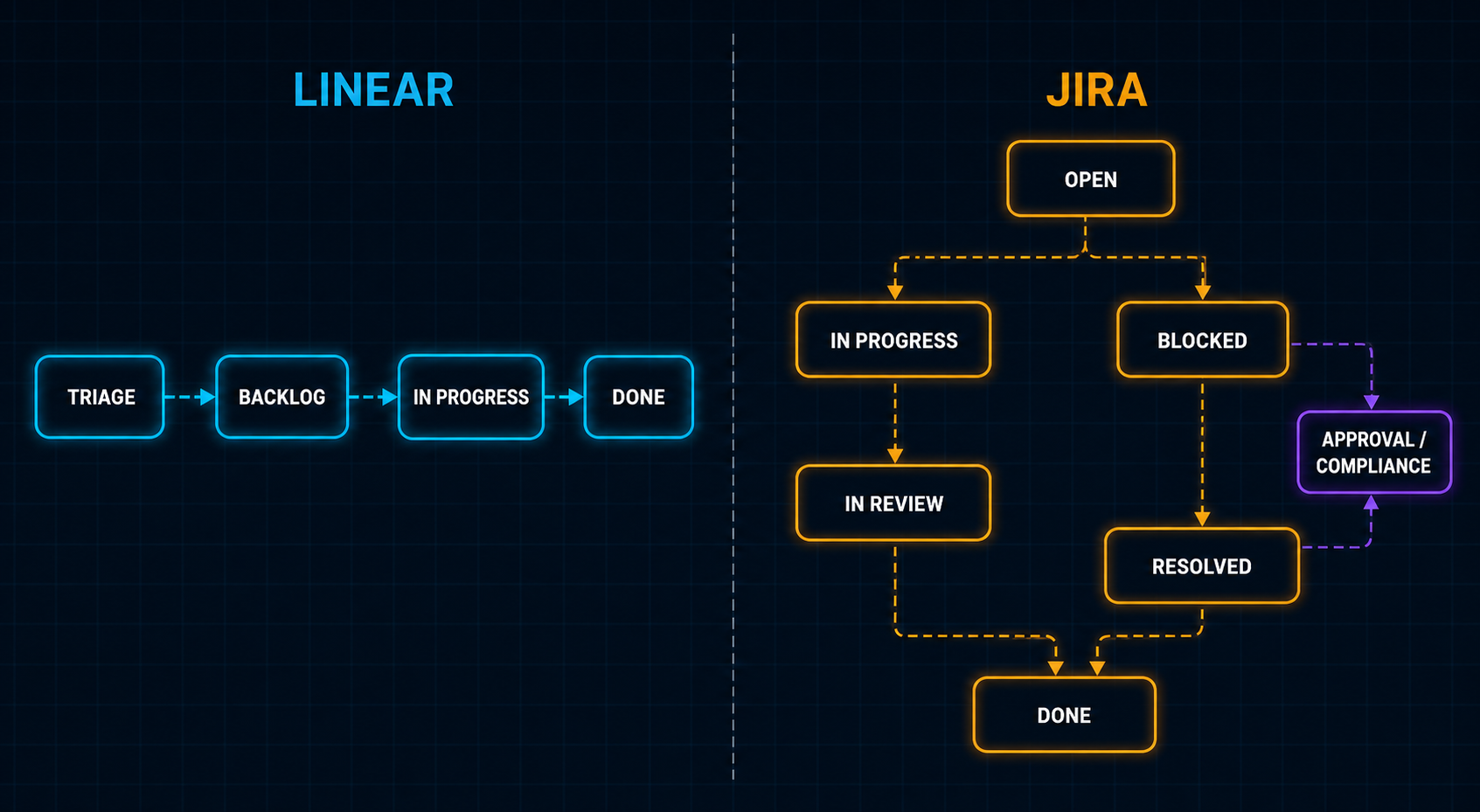
Neither of these is objectively better. One is a fixed, fast lane. The other is a general-purpose highway system with on-ramps for every kind of traffic.
Where Each One Breaks
Linear breaks down at the edges of engineering. The moment Support needs to log customer-reported issues with SLA tracking, or Legal needs a formal review-and-sign-off trail, or a compliance audit needs a defensible history of who approved what and when, Linear's opinionated simplicity becomes a wall. You can bolt on integrations, but you're now fighting the tool's design instead of using it.
Jira breaks down at the center of engineering. Small, fast-moving product teams doing weekly cycles feel every bit of Jira's generality as friction: extra clicks, fields nobody fills in correctly, a workflow someone configured two reorgs ago that no longer matches how the team actually works. The same flexibility that makes Jira indispensable at the org level makes it feel like a tax at the team level.
The failure mode isn't picking the "wrong" tool. It's picking the right tool for the team you have today and never revisiting the decision as the team's shape changes.
A Decision Framework, Not a Verdict
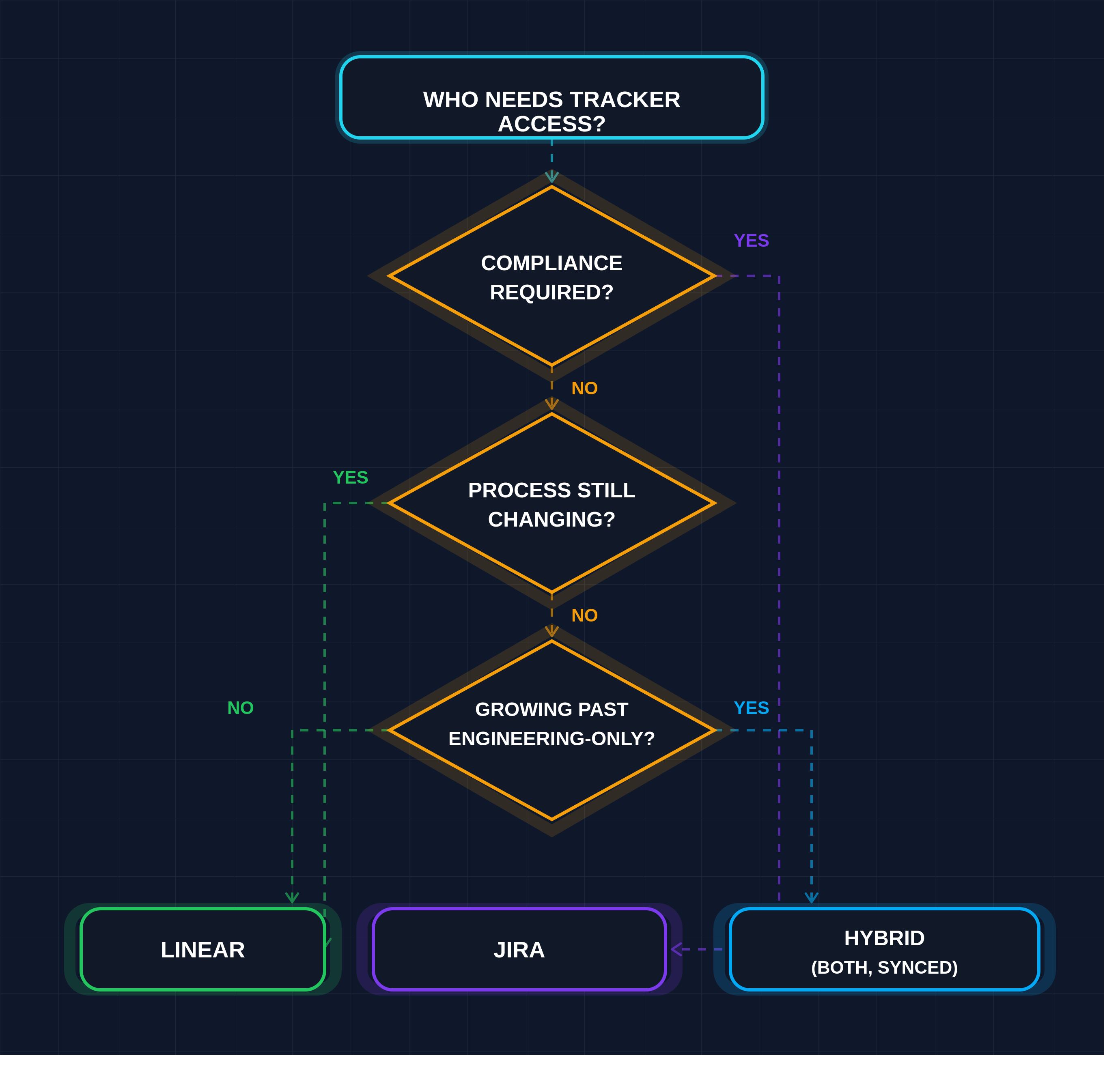
Instead of asking "which tool is better," tech leads get more useful signal from four questions:
- Who actually needs write access to the tracker? If it's engineering only, Linear's opinionated workflow is a feature. If Support, Sales, or Legal need their own views and fields, that's Jira's home turf.
- Do you have a compliance or audit requirement? Regulated industries — health, finance, defense — often need formal approval chains and immutable history that Jira's workflow schemes handle natively and Linear doesn't attempt to.
- How fast does your team's process actually change? Linear assumes your cycle rhythm is roughly stable. If your process is still being invented — new team, new domain — Jira's configurability absorbs that churn without a tool migration.
- What's your growth trajectory over the next 12–18 months? A 6-person product team staying at 6–10 people can live in Linear indefinitely. A 6-person team about to become a 60-person, multi-department org is optimizing for a shape it won't have for long.
None of these questions have a universally "right" answer — they have an answer for your organization, which is exactly why the generic "Linear vs. Jira" ranking posts are close to useless.
The Trend Worth Watching: Nobody Actually Picks Just One
The pattern showing up more often in engineering orgs isn't "we migrated from Jira to Linear" or vice versa — it's both, connected. Engineering runs in Linear for the speed and low ceremony. Anything that needs cross-functional visibility, compliance, or a permanent record gets synced to Jira, or a similar system of record, through Linear's native two-way Jira integration or a middleware tool.
This isn't a compromise so much as an admission that the underlying problem — engineering wants speed, the rest of the org wants structure — doesn't have a single-tool solution. It has an integration solution.
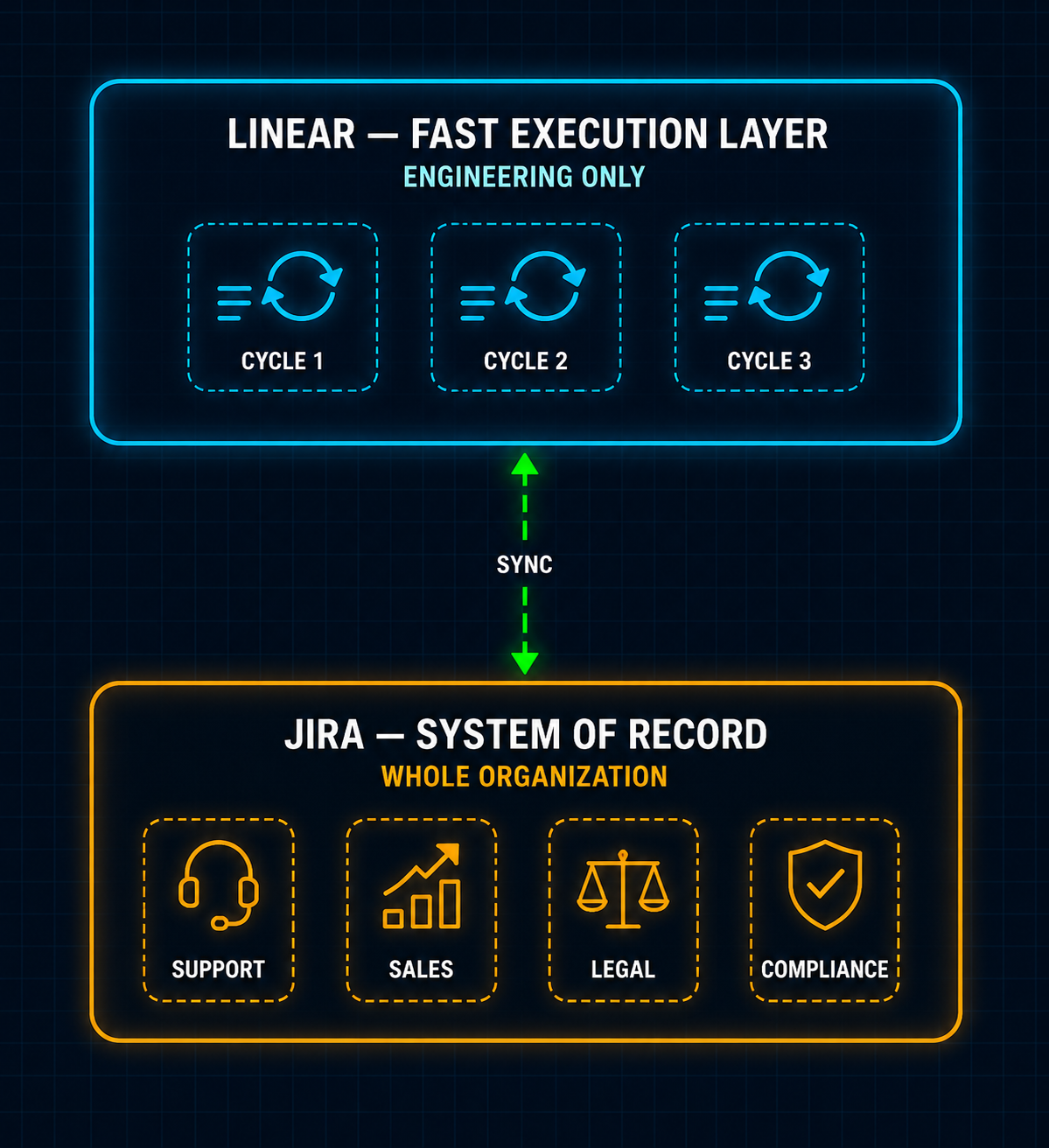
That's worth saying plainly because it cuts against how these tools are usually marketed. Linear's pitch is that it replaces Jira. Jira's pitch is that it's the system every team should live in. In practice, the healthiest setups increasingly treat them as two layers rather than two competitors: a fast execution layer for engineering, and a system-of-record layer for the organization.
Actionable Takeaways
If you're the one making this call:
- Map who touches the tracker today, not who might in the future. Engineering-only teams should default to Linear and revisit only when a second department needs real access — not preemptively.
- Don't configure Jira to feel like Linear. Stripping Jira down to mimic Linear's simplicity fights the tool's design and usually regresses the first time someone adds a field back. If you want Linear's workflow, use Linear.
- Don't force compliance requirements into Linear via workarounds. If an auditor needs a defensible approval trail, build that in the tool designed for it rather than duct-taping it onto a tool with no concept of formal sign-off.
- Budget for the migration cost honestly. Moving a team's history, links, and habits between trackers is expensive in time and lost context — it's cheaper to get the initial choice right than to switch twice.
- Consider the hybrid model early, not as a last resort. If you already know engineering and the rest of the org have different needs, wiring Linear and Jira together from the start is often less work than a full migration later.
Conclusion
The Linear vs. Jira debate keeps getting fought on the wrong terrain — speed versus power, modern versus legacy, delightful versus enterprise. The more durable question is which tool's built-in theory of how work should flow matches the organization you actually have, and the one you're likely to become.
Get that mapping right, and the "boring" tool stops feeling boring, and the "fast" tool stops feeling limiting. Get it wrong, and no amount of configuration — or complaining — will fix it.
If you're mid-debate on this at your own company: what's actually driving the conversation — team speed, or something a non-engineering stakeholder needs that nobody's said out loud yet?
